
Best Dog Toys for Vision: 2026 Guide for Blind Dogs
Table of Contents
- Why Vision Loss Changes Toy Choices
- Top Sensory Toys for Blind Dogs
- How to Play with a Blind Dog: A Step-by-Step Guide
- Best Dog Toys for Senior Dogs with Vision Issues
- Safety and Material Toxicity: What to Avoid
- DIY Sensory Toy Modifications
- Conclusion
- Frequently Asked Questions
Last Updated: September 9, 2026
Why Vision Loss Changes Toy Choices
A dog losing its sight doesn't lose its need to play, but it does lose the primary way most toys are designed to be found. The best dog toys for vision loss focus on sensory engagement rather than visual appeal, shifting the burden from the eyes to the nose and ears.
Many pet owners assume a blind dog simply adapts, but research suggests that owners widely believe feeding enrichment toys provide essential mental stimulation and prevent boredom in companion dogs NCBI study on enrichment toys for companion dogs. That instinct is correct, yet the execution often misses the mark. Most standard toys on the market are designed with bright colors and movement in mind, features that mean nothing to a dog navigating the world by scent and sound.
The toys that genuinely help visually impaired dogs replace visual cues with tactile, auditory, and olfactory ones, building confidence and reinforcing spatial awareness.
Top Sensory Toys for Blind Dogs
The best dog toys for vision issues engage senses other than sight. Scent-based toys, noisemaking options, and treat-dispensing puzzles each serve a distinct purpose, and most blind dogs benefit from a rotation of all three.
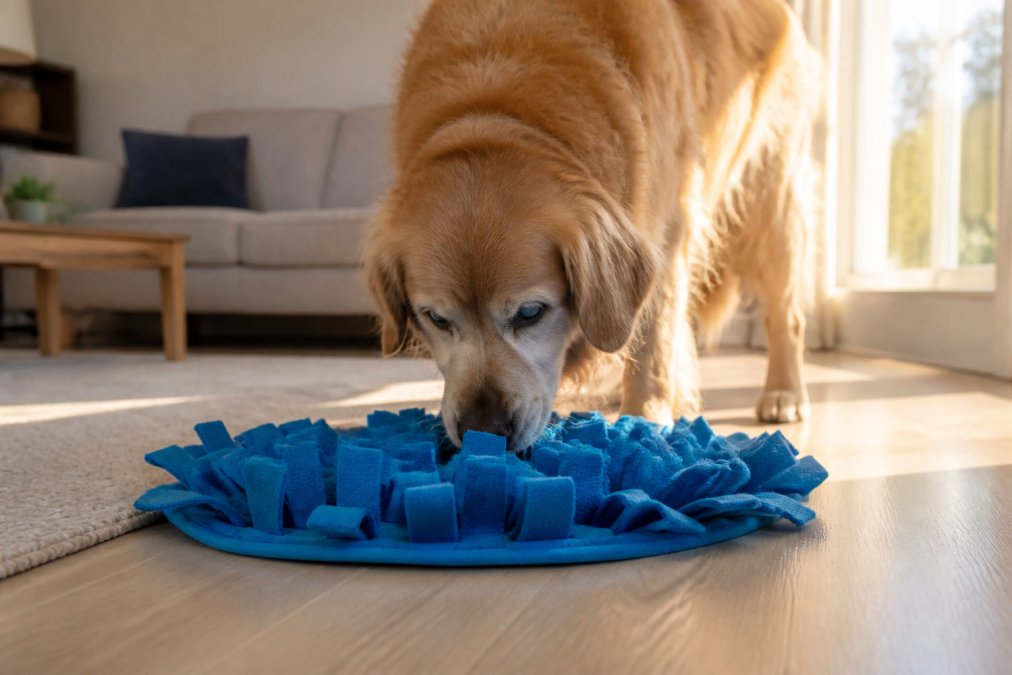
Scent-Based Toys and Snuffle Mats
Scent is the most reliable channel for a blind dog. Snuffle mats, which hide kibble or treats within fabric strips, encourage natural foraging behavior and reward scent tracking with food.
Scented balls and plush toys infused with odor also work well. Current industry guidance for dogs with vision impairment emphasizes shifting focus from visual stimulation to auditory and olfactory engagement, specifically recommending scented toys and treat-dispensing puzzles Reddit r/seniordogs discussion on toys for blind pups. For dogs with some remaining vision, color contrast matters: blue and yellow toys stand out best against green grass, while red toys are nearly invisible to canine eyes DogVision guidance on color perception.
Noisemaking and Auditory Toys
Sound gives a blind dog a moving target to track. Squeaky toys, crinkle balls, and bells inside plush toys let a dog locate the toy by ear, provided the sounds are consistent and predictable.
Leaving a crinkle toy or squeaky ball accessible during quiet time lets a blind dog initiate play on its own terms, which is crucial for independence.
Treat-Dispensing Puzzles
Puzzle toys that require a dog to nudge, roll, or paw open compartments to release treats work well because they are stationary, the dog only needs to figure out how to access the reward.
Not every puzzle suits every dog, though. Some owners note that while puzzles and treat-dispensing toys are popular, they may not work universally, as individual comfort levels with new, complex toys vary Blind Dog Support community observations. Start with a simple, easy-to-open puzzle and watch how your dog reacts before increasing difficulty.
How to Play with a Blind Dog: A Step-by-Step Guide
Playing with a blind dog requires you to become the toy's anchor. The best dog toys for vision loss only work if introduced in a way that builds trust.
- Start in a quiet, familiar room. Remove obstacles and keep the space consistent so your dog can map the area by memory and scent.
- Introduce the toy by scent first. Hold it near your dog's nose and let them sniff it thoroughly before any movement begins.
- Add sound or movement slowly. If the toy squeaks, squeeze it once near the ground. If it's a treat puzzle, let your dog watch you place a treat inside.
- Keep the toy stationary initially. Toss it only a few inches at first, then gradually increase the distance as your dog's confidence grows.
- Use a verbal cue. A consistent word like "find it" teaches your dog that play is starting and helps them focus on the task.
- End on a success. Always finish with a treat found or a toy "caught" so the experience ends positively.
The goal is supervised play that builds spatial awareness without causing frustration. If your dog seems anxious, step back to an easier version of the game and reinforce every small attempt.
Best Dog Toys for Senior Dogs with Vision Issues
Age compounds the challenge. Senior dogs often face vision loss alongside reduced mobility, dental sensitivity, and slower cognitive processing, so the best dog toys for senior dogs prioritize softness, accessibility, and low physical demand. But "senior" is not a single category, a 7-year-old large-breed and a 14-year-old small-breed have very different needs.
The Three Overlapping Challenges
Joint pain and arthritis. According to the American Veterinary Medical Association, arthritis affects one in five dogs, and prevalence rises sharply with age. Toys that require standing and batting are less useful than toys that can be engaged while lying down.
Dental sensitivity. Senior dogs commonly have periodontal disease, loose teeth, or exposed roots. Hard nylon chews and dense rubber bones can cause significant pain or tooth fracture. The hardness of the toy must match the current state of the dog's teeth.
Cognitive decline. Canine Cognitive Dysfunction (CCD) is the dog equivalent of Alzheimer's disease, with signs often appearing in dogs over 10 years old. Environmental enrichment, including puzzle toys and scent work, may help slow cognitive decline.
Toy Selection by Physical Capacity
For dogs with significant mobility loss: Favor flat, stationary toys usable while lying down, such as a shallow snuffle mat or a puzzle that releases food with a gentle nudge or lick. Avoid toys that roll away.
For dogs with moderate mobility: A soft, lightweight plush toy with minimal stuffing is easier to grip than a heavy rope toy. Latex rubber toys offer gentle resistance, look for latex soft enough to indent with a fingernail.
For dogs with good mobility but vision loss: The priority shifts to cognitive engagement. A treat-dispensing puzzle that stays in one place gives them a task that does not require navigation, building confidence.
Treat-Dispensing Toys: The Difficulty Gradient
Not all puzzle toys are appropriate for senior dogs. Many commercial puzzles demand fine motor control that arthritis can impair. The best senior-friendly puzzles use a simple action:
- Level 1 (easiest): A flat mat with shallow pockets that release treats with a single lick or nose press.
- Level 2 (moderate): A silicone cup that must be tipped over with the nose or paw.
- Level 3 (harder): A rolling ball with holes that dispenses treats as it is pushed. This is only appropriate for seniors with good mobility.
Start at Level 1 and observe. If your dog solves it in under two minutes, move up; if frustrated, step back down. The goal is mental stimulation without physical strain.
Scent Work as a Cognitive Preservative
Scent-based toys are particularly valuable for senior dogs because they require minimal physical effort while providing substantial cognitive load. A dog using its nose engages the olfactory bulb, which has direct neural connections to memory and emotion areas.
For a senior dog, simplify the scent work: scatter kibble on a flat towel, then roll it loosely as your dog improves. This graduated difficulty keeps the brain engaged without straining arthritic paws.
The Rotation Principle
A senior dog with vision loss needs enrichment that matches their physical capacity. Rotating between a flat scent mat, a soft squeaky plush, and a Level 1 puzzle keeps an aging brain challenged without overwhelming an aging body.
When to Retire a Toy
Senior dogs change quickly. Reassess your dog's toy collection whenever you notice a change in mobility, eating habits, or enthusiasm for play. Retire any toy your senior dog no longer engages with, as a toy that is now too difficult can cause frustration.
Safety and Material Toxicity: What to Avoid
Safety becomes the dominant concern when a dog cannot see what it is chewing. A blind dog relies on mouth and nose to explore, so the material matters more than shape or color. The best dog toys for vision are made from non-toxic, durable materials.
Most ranking articles focus on function but almost none address what the toy is made of, a critical oversight. A blind dog cannot visually inspect a toy for wear, and anxiety-driven chewing is common.
What the Regulations Actually Say
The Consumer Product Safety Improvement Act (CPSIA) of 2008 set strict limits on lead and phthalates in children's products, but dog toys are not subject to those mandates. The FDA regulates edible chews but not plush or rubber toy materials, leaving the burden on manufacturers' voluntary standards and your own scrutiny.
When a manufacturer claims a toy is "non-toxic," that claim is often based on self-reported compliance with ASTM F963, originally developed for children's toys. Some reputable brands voluntarily test to these standards, but many do not.
Specific Materials to Avoid and Why
PVC and vinyl. These materials often require plasticizers, frequently phthalates, which have been linked to endocrine disruption in animal studies. A blind dog that chews persistently can ingest measurable amounts over time.
Cheap imported rubber. The term "rubber" can mean natural latex or synthetic rubber. Synthetic rubber from unregulated sources may contain BPA, an endocrine disruptor with no equivalent restriction for pet toys.
Hard nylon and bone-style chews. These are not toxic but pose a fracture risk. A blind dog cannot see sharp edges that develop from chewing, and dental fractures are a common reason for veterinary visits.
Small parts and glued components. Buttons, plastic eyes, and bells can detach and become a choking hazard or cause an intestinal blockage. A blind dog cannot see that a toy is coming apart and will continue chewing until the part is swallowed.
What to Look For Instead
Seek toys with explicit labeling for:
- BPA-free and phthalate-free, This should be printed on the packaging, not just implied.
- Food-grade or FDA-compliant silicone, Silicone is inherently more stable than rubber and does not require plasticizers.
- Natural latex, If the toy is rubber, natural latex from a named source (e.g., Hevea milk) is preferable to unspecified synthetic blends.
- ASTM F963 compliance, This is the voluntary standard used for children's toys, and it covers mechanical hazards, flammability, and heavy metals. Brands that test to this standard for their pet lines are doing more than the minimum.
The Visual Wear Indicator
Some manufacturers now integrate a colored inner layer that becomes visible only when the outer rubber has been compromised, giving owners a clear signal to replace the toy before it becomes a hazard Dognition review of top dog toys for 2026. This design feature is especially valuable for blind dogs because the dog itself cannot tell you when a toy is falling apart. The visual cue substitutes for the dog's own visual inspection.
Practical Inspection Protocol
Because a blind dog explores by mouth, establish a routine inspection schedule:
- Before each play session, run your fingers over the entire surface of the toy, feeling for cracks, rough edges, or soft spots that indicate internal damage.
- After each play session, squeeze the toy to check for air leaks (in squeaky toys) and inspect seams for fraying.
- Weekly, wash rubber and silicone toys in warm, soapy water and rinse thoroughly. Plush toys should be laundered or replaced if they cannot be machine washed.
- Replace any toy at the first sign of wear. For a blind dog, a worn toy is not a minor issue; it is an active hazard.
A blind dog's relationship with a toy is fundamentally different from a sighted dog's: the toy will be mouthed more, chewed more persistently, and inspected less. Choosing toys with verified non-toxic materials and a clear wear indicator is one of the most concrete ways you can protect a dog that cannot protect itself.
DIY Sensory Toy Modifications
You don't need to buy a new arsenal to help a blind dog play well. Many standard toys can be modified with minimal effort and no special tools.
Add scent to any toy. Rub a small amount of peanut butter or a dog-safe scent like vanilla extract onto a plush toy to give your dog a clear target to locate.
Turn a muffin tin into a puzzle. Place treats in several cups, then cover each with a tennis ball. Your dog must nose or paw the balls away to find the treats.
Create a noise layer. Slip a crinkle packet or bell inside an old sock, tie it off, and you have a noisemaking toy. Supervise closely to ensure the sock isn't shredded and ingested.
Upgrade a snuffle mat. If you already own one, increase difficulty by scattering kibble on top rather than burying it all, then gradually bury more as your dog improves.
These DIY options engage your dog's remaining senses and let you test which type of sensory engagement your dog responds to before investing in specialized products.
Conclusion
Choosing the best dog toys for vision loss comes down to a simple principle: play to the senses your dog still has. Scent-based toys, noisemaking options, and treat-dispensing puzzles each offer a way for a blind dog to experience play without relying on sight, building confidence and strengthening your bond.
The challenge is finding toys that are genuinely safe and durable enough for a dog that explores by mouth. We have pet products, and we are always adding new products.
Find the toy that lets your blind dog play with confidence again.
Frequently Asked Questions
What are the best stimulating toys for blind dogs?
The best stimulating toys for blind dogs engage senses other than sight. Scent-based toys like snuffle mats and scented balls, noisemaking toys with squeakers or bells, and treat-dispensing puzzles are top choices. These toys encourage natural behaviors like sniffing and foraging, providing mental stimulation and confidence. When choosing, focus on toys that offer strong olfactory or auditory feedback to help your dog locate and interact with them successfully.
Are squeaky toys good for blind dogs?
Yes, squeaky toys are excellent for blind dogs because they provide clear auditory feedback. The sound helps your dog pinpoint the toy's location, making play more accessible and less frustrating. This auditory stimulation also builds confidence and encourages active play. Choose toys with a consistent, easy-to-locate squeak sound.
What color toy would a dog see most clearly?
Dogs see the world in shades of blue and yellow. For a dog with remaining vision, toys in these colors offer the highest contrast against common backgrounds like green grass. Red toys appear gray or brown to dogs and are harder to distinguish. Choosing blue or yellow toys can help a visually impaired dog track movement and find the toy more easily.
How can I make playtime safer for a dog with vision loss?
To make playtime safer, always supervise your dog and play in a familiar, clutter-free area. Use verbal cues and a consistent command like 'find it' before throwing a toy. Choose soft toys to prevent injury from collisions. Introduce new toys by letting your dog sniff them first. Never move furniture, as this can disorient a blind dog.