
Yellow Dog Toys for Better Visibility: What Works
Table of Contents
- Why Toy Color Matters for Your Dog's Playtime
- How the Canine Color Vision Spectrum Shapes Toy Choices
- Yellow vs. Blue: Which Color Stands Out Most?
- Matching Yellow Dog Toys to Grass, Water, and Indoor Floors
- Why Red and Green Toys Fail the Visibility Test
- Best Dog Toys for Senior Dogs and Low Vision Needs
- Interactive Dog Toys for Low Vision: Beyond Color
- Final Thoughts on Choosing High-Visibility Toys
- Frequently Asked Questions
Last Updated: September 5, 2026
Why Toy Color Matters for Your Dog's Playtime
Most owners assume dogs see the world in black and white, but that is a myth. Dogs possess dichromatic vision, meaning they perceive the world primarily in shades of blue and yellow. This biological fact transforms how we should shop for toys. When you toss a bright red ball onto green grass, your dog does not see a vivid contrast; they see a muted, grayish object that blends into the background. Choosing yellow dog toys for better visibility is not about aesthetics; it is about maximizing engagement, retrieval success, and overall play satisfaction for your canine companion.
At Tech Sphere and More, we offer products to help owners make informed choices. A 2023 study published by the National Center for Biotechnology Information found that introducing new toys to companion dogs resulted in a slight improvement in positive behavioral outcomes. That improvement diminishes, however, if the dog cannot find or track the toy effectively. Below, we will show you exactly how color physics, environmental factors, and age-related vision changes dictate which toys your dog will actually chase. The 8 sections we cover will help you select toys that respect your dog's unique visual system.
How the Canine Color Vision Spectrum Shapes Toy Choices
The canine color vision spectrum is fundamentally different from human trichromatic vision. Humans have three types of color-receptive cones in their retinas, allowing us to see red, green, and blue. Dogs have only two types of cones. This means they see a world composed primarily of blue, yellow, and shades of gray. Red and green appear as muddy browns or grays because those wavelengths do not stimulate the canine retina effectively.
This vision science dictates that high-visibility toys should be manufactured in colors that stimulate the two functioning cone types. Blue and yellow are the most distinct and visible colors for dogs compared to others, according to Pet Assure's guidance on toy colors. The practical implication is clear: when you shop for fetch toys, tug ropes, or chew items, the canine color vision spectrum should be your primary filter.
Yellow vs. Blue: Which Color Stands Out Most?
Yellow is generally the superior choice for outdoor play, but the answer depends on your environment. Blue toys are excellent for grassy areas because blue contrasts sharply against the green chlorophyll that dogs perceive as a grayish tone. Yellow toys, however, are the best all-around option because they offer high visibility across the widest range of surfaces, from dirt to concrete to indoor flooring.
The context matters more than most guides admit. While yellow is highly visible in many settings, blue may be more effective for visibility against green grass, whereas yellow or green (perceived as yellow) is superior for water play, a point raised in discussions on animal vision science. If you play primarily on a manicured lawn, a blue toy might outperform a yellow one. If your play spans varied terrain, a bright yellow toy is the safer, more versatile pick.
Matching Yellow Dog Toys to Grass, Water, and Indoor Floors
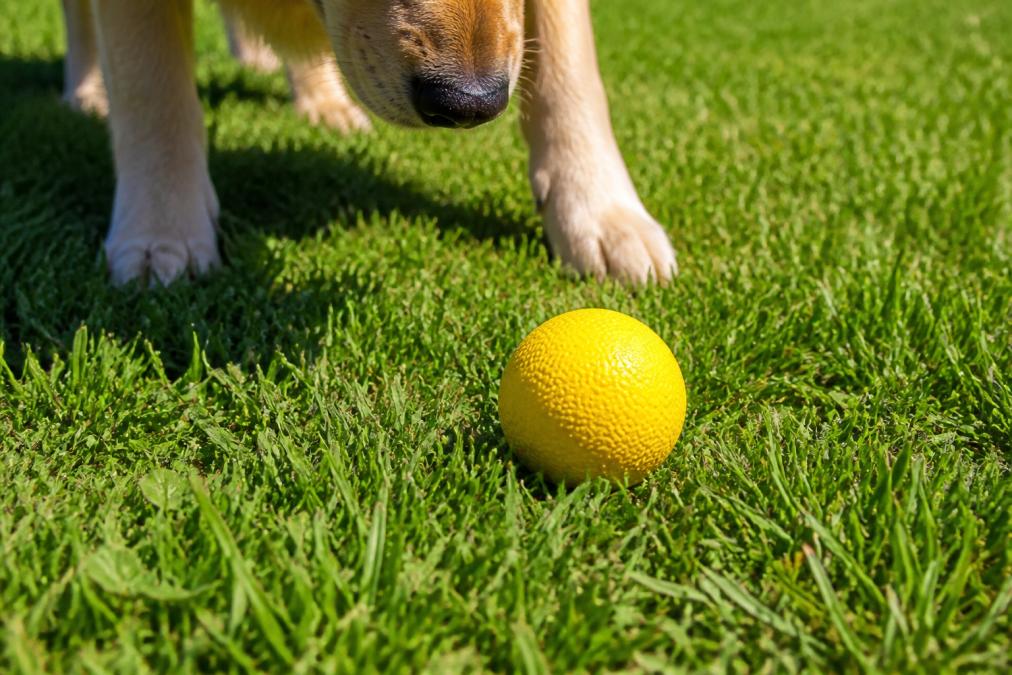
Selecting the right yellow dog toys for better visibility requires matching the shade to your primary play surface. On grass, a bright, almost neon yellow works well because it contrasts with the darker, grayish-green that dogs perceive. In water, yellow is the gold standard; it remains visible on the surface even in choppy conditions, whereas blue toys can vanish against a blue sky reflection.
Indoor play presents a different challenge. Hardwood floors, area rugs, and shadows create variable contrast. A yellow toy with a high-gloss finish reflects more light, making it easier for your dog to track during indoor fetch sessions. For senior dogs, the contrast between a bright yellow toy and a darker floor is often the difference between an engaged dog and one that gives up searching.
Why Red and Green Toys Fail the Visibility Test
Red and green toys are effectively invisible to most dogs. Because dogs lack the cone type that detects red wavelengths, a red toy appears as a dark gray or brown object. On green grass, a red toy blends into a single, muddy visual field. This is not a minor inconvenience; it directly impacts play quality.
When a toy disappears against the background, the dog loses visual tracking, which leads to frustration and reduced interest in retrieval. Research from Happy Staffy Co. on training tool colors indicates trainers are increasingly using blue and yellow targets to help dogs focus and identify commands more clearly. The same logic applies to toys. If you have ever watched your dog run past a red toy they were supposedly fetching, this is why.
Best Dog Toys for Senior Dogs and Low Vision Needs
Age-related vision changes make color selection even more critical for older dogs. As dogs age, their lenses thicken and become more opaque, reducing the amount of light that reaches the retina. This condition, called lenticular sclerosis, affects nearly all senior dogs to some degree. The result is reduced visual acuity and a decreased ability to distinguish contrast in dim lighting.
The best dog toys for senior dogs incorporate maximum contrast and high-gloss surfaces. A DIY high-visibility spiral tug toy designed specifically for canine color vision spectrums improved engagement and visibility for a senior dog during play sessions, according to a case study from Dalmatian DIY. When selecting toys for an aging dog, choose bright yellow toys with a shiny or reflective surface. These reflect more light into the eye, compensating for the thickened lens and helping the dog track movement more easily.
Interactive Dog Toys for Low Vision: Beyond Color
Color is only one variable in the equation. For dogs with significant vision loss, interactive dog toys for low vision must incorporate other sensory cues. Scent-based play becomes essential, as does toys with squeakers that provide an auditory location marker. A toy that combines a bright yellow exterior with a loud squeaker and a treat-dispensing function engages multiple senses simultaneously.
Motion tracking also matters. Dogs with low vision rely heavily on peripheral vision and motion detection. A toy that moves erratically or bounces unpredictably is easier for a low-vision dog to locate than one that rolls in a straight line and stops. When shopping, look for yellow toys with irregular bounce patterns. These stimulate the dog's motion tracking abilities, compensating for reduced visual clarity.
Final Thoughts on Choosing High-Visibility Toys
| Play Environment | Best Color | Why It Works | Recommended Toy Type |
|---|---|---|---|
| Green grass lawn | Blue or bright yellow | Contrasts with grayish-green perception | Fetch balls, rings |
| Water (lake, pool) | Yellow | Remains visible on surface | Floating fetch toys |
| Indoor hardwood | High-gloss yellow | Light reflection aids tracking | Tug toys, soft chew |
| Low-light/senior play | Neon yellow | Maximum light reflection | Squeaky plush toys |
Choosing yellow dog toys for better visibility is a small change with a measurable impact on your dog's happiness. The science of canine color perception is well established, yet most toy aisles remain stocked with red and orange products that dogs can barely see. By focusing on yellow and blue options, matching the shade to your play environment, and considering age-related vision changes, you can turn every play session into a success.
At Tech Sphere and More, we carry a curated selection of high-visibility pet products alongside our innovative tech gadgets, and we are always adding new items to our inventory. Whether you are outfitting a playful puppy or a senior dog with specific needs, choosing toys that match the canine color vision spectrum ensures your pet stays active, engaged, and happy.
Frequently Asked Questions
Can dogs see the color yellow clearly?
Yes. Dogs have dichromatic vision, meaning they see the world in shades of blue and yellow. Yellow appears as a bright, distinct color to them, unlike red or green which look grayish or brownish. This makes yellow dog toys highly visible on most backgrounds, especially green grass where the contrast is strong.
What color toy is easiest for a dog to see?
Blue and yellow toys are the easiest for dogs to see because their retinas contain two types of color receptors tuned to those wavelengths. For fetch in a grassy yard, yellow offers the strongest contrast. For indoor play on carpet or hardwood, blue toys often stand out better against warm-toned floors.
What are the best dog toys for senior dogs with declining vision?
Look for toys in bright yellow or blue with high contrast against your floors and yard. Squeaker toys help dogs with low vision locate the toy by sound, while interactive treat-dispensing toys engage their sense of smell. Soft, lightweight fetch toys are gentler on aging teeth and jaws.
Why are blue and yellow the best colors for dog toys?
Dog eyes have only two types of cones, compared to three in humans. This means they perceive blue and yellow clearly while red and green appear muted or gray. Choosing toys in these visible colors helps your dog track movement, improves fetch success, and keeps them engaged during play.
Finding the right toy for a dog with changing vision can feel overwhelming. Tech Sphere and More simplifies that search by offering high-visibility toys and tech-enhanced pet accessories in one convenient store. Explore our pet collection and discover toys designed with your dog's vision in mind. Get started with Tech Sphere and More and give your dog a playtime they can actually see.