
Best Dog Toys for Senior Dogs: 2026 Gentle Play Picks
Table of Contents
- Why Senior Dogs Need Different Toys
- Quick Comparison: Best Dog Toys for Senior Dogs
- How to Keep a Senior Dog Mentally Stimulated
- Best Puzzle Toys for Senior Dogs
- Dog Toys for Seniors With Arthritis
- Choosing Toys for Sensitive Teeth and Gums
- Safety, Supervision, and Toy Rotation
- Conclusion
- Frequently Asked Questions
Last Updated: September 17, 2026
Why Senior Dogs Need Different Toys
Aging changes play. Research from Reviehub's 2026 senior dog toy review shows that senior dogs need toys built around joint safety, dental gentleness, and cognitive stimulation without overexertion. At Tech Sphere and More, we've watched that shift reshape what owners should buy. The best dog toys for senior dogs are not simply softer versions of puppy toys; they are designed around a different body and a different brain.
Joint Safety, Dental Gentleness, and Cognitive Support
Three needs separate senior play from adult play. Aging teeth and gums call for soft-density rubber and flexible nylon instead of hard plastic. Arthritic joints rule out high-impact tugging and jumping. And cognitive decline responds to enrichment: puzzle solving, scent-based play, and treat-dispensing toys that keep a dog thinking rather than sprinting.
Quick Comparison: Best Dog Toys for Senior Dogs
Here is the short version before the detail. Each pick below maps to a specific senior need, so match the toy to the problem rather than the other way around.
| Toy | Price | Best For | Key Strength |
|---|---|---|---|
| Pet Dog Chew Toy Molar Toothbrush | $30.62 | Dental health and gentle chewing | Soft, elastic, BPA-free material |
| CozyPlush Pet Bed | $141.17 | Joint support during rest | Thickened padding for joints |
| Dog Injury Travel Auxiliary Strap | $67.25 | Mobility support on walks | Adjustable, breathable support |
| Lamb Cashmere Kennel | $56.97 | Small seniors under 5 kg | Soft fleece warmth |
| Waterproof Fabric Pet Bed | $301.69 | Incontinence-prone seniors | Removable, washable cover |
| Pet Cleaning Gloves & Wipes | $39.16 | Dental and grooming care | Tooth, ear, and eye wipes |
How to Keep a Senior Dog Mentally Stimulated
Mental stimulation is the most underrated part of senior care. A 2026 industry analysis from Future Market Insights' dog toys market report found training-focused toys made up 47.6% of the product category share as of 2025, and that demand is strongest for dogs that can no longer run. Keep sessions short, five to ten minutes, and stop while the dog is still engaged.

Scent-Based Play and Snuffle Mats
Scent work suits seniors because it demands almost no physical effort. Hide treats in a snuffle mat or folded towel and let the dog work by nose. For dogs with vision or hearing loss, scent-based play becomes the primary channel, not a bonus. Rotate the hiding spots so the game stays novel.
Best Puzzle Toys for Senior Dogs
The best puzzle toys for senior dogs are treat-dispensing designs with low lips and wide compartments, not the tight, complex puzzles built for young dogs. Puzzle solving keeps the brain active, but a toy that frustrates a senior gets abandoned. Start easy, then increase difficulty only when the dog solves the first level quickly.
Dog Toys for Seniors With Arthritis
Arthritis-friendly play is a mechanics problem, not a softness problem. A toy can be plush and still hurt a stiff dog if it forces sudden direction changes, deep neck flexion, or a jarring stop. The goal is to keep the dog's spine, hips, and wrists in a neutral line while the toy moves slowly and stays close to the floor.
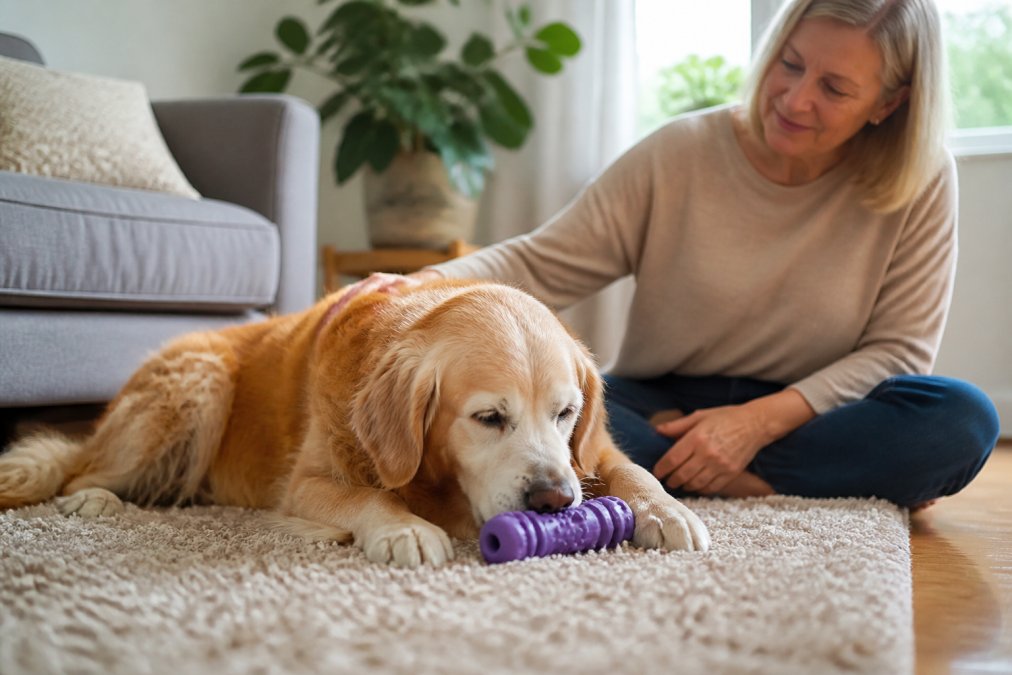
How Toy Shape Changes Joint Load
Most practitioners find that the shape of a toy matters as much as its material. Here is how the common categories load an arthritic body:
- Flat, low-rolling toys (discs, wide-bottom wobblers) travel a short distance and stop on their own, so the dog does not have to lunge or pivot. Best for dogs with hip or knee arthritis.
- Long, soft tug toys let a dog pull from a lying or standing position without jumping. The key is a short, low tug, never a jerking, upward pull that loads the cervical spine.
- Weighted or sand-filled toys stay put when nudged, which reduces the reach-and-grab motion that strains the shoulders.
- Erratic bouncers and high-rebound balls are the worst offenders. They force sudden turns and stops, which is exactly the motion stiff joints cannot absorb.
Play Positions That Spare the Joints
Fetch does not have to disappear, it has to change. Rolling a toy a few feet along the ground keeps the dog's head low and the stride short. Tug becomes a gentle, horizontal pull from a stable stance. Nose work and floor-level puzzles let the dog engage from a down position, which unloads the hips entirely.
Adapting for Vision and Hearing Loss
- High-contrast colors (a bright toy on a light floor, or vice versa) help a dog with failing vision track a slow-rolling toy.
- Scent-based toys, treat-stuffed rubber, snuffle mats, scent-impregnated fabric, let a dog with low vision or hearing play entirely by nose.
- Vibration and texture give feedback a dog can feel rather than see or hear, which keeps engagement high when the other senses fade.
The Pet Dog Chew Toy Molar Toothbrush fits the arthritis category because its elastic material lets a dog chew from a resting position. For dogs recovering from injury or struggling on walks, the Dog Injury Travel Auxiliary Strap adds support without strain.

Choosing Toys for Sensitive Teeth and Gums
Dental gentleness is non-negotiable once a dog passes middle age. Industry data from Chewy's 2026 pet product trends points to a clear move toward soft-density rubber, flexible nylon, and fabric-based toys to accommodate aging teeth and gums. Hard plastic and antler-style chews cause fractures in weakened teeth, and a fractured tooth in a senior dog often means extraction under anesthesia, which carries its own risks.
Soft-Density Rubber and Flexible Materials
Squeeze the toy before buying. If it barely gives under thumb pressure, it is too hard for a senior mouth. Soft-density rubber and flexible materials bend, which spreads chewing force instead of concentrating it on one tooth.
Pet Dog Chew Toy Molar Toothbrush →
Matching Toy Size to Jaw and Tooth Condition
Size is as important as density. A toy that is too small invites a dog to gnaw at the back molars, where fractured teeth are most common. A toy that is too large forces the jaw open and strains the temporomandibular joint. The right size lets the dog chew comfortably with the mouth mostly closed.
- Small seniors (under 10 lb): choose toys sized for the mouth, not the breed label. A toy marketed for 'small dogs' may still be too firm.
- Medium and large seniors: look for toys with a soft core and a textured outer layer, so the dog gets grip without a hard bite surface.
- Dogs missing teeth: fabric and plush options with no hard core are often the only safe choice.
Reading Wear Before It Becomes a Hazard
Supervised chewing still matters: no toy is indestructible, and worn edges should be retired. Check weekly for:
- Cracks deep enough to catch a fingernail
- Loose squeakers or plastic inserts that could be swallowed
- Frayed rope ends that can unravel into strands
- A surface that smells of degraded rubber or sheds material on your hand
Dental Chews vs. Chew Toys
Edible dental chews and rubber chew toys do different jobs. Chews address plaque along the gumline through abrasion and saliva flow; rubber toys provide safe, repetitive gnawing that satisfies the urge without adding calories. For a senior on a weight-management plan, a soft rubber chew toy is often the better daily default, with an edible chew used a few times a week under supervision.
Safety, Supervision, and Toy Rotation
Rotation is the cheapest enrichment tool available. Keep four to six toys in circulation, swap two out every week, and store the rest. The dog treats each returned toy as new, which refreshes interest without a single purchase.
Safety rules for senior play:
- Supervise chewing until you know how the dog handles each toy
- Inspect weekly for cracks, loose pieces, and worn edges
- Retire any toy that sheds material or smells of degraded rubber
- Skip rope tug and high-impact fetch for arthritic dogs
- Wash fabric toys and beds regularly to limit bacteria
Conclusion
The hardest part of senior play is accepting that the dog who once chased a ball for an hour now needs a different kind of engagement. That is not decline; it is a change in the rules. Tech Sphere and More stocks the pieces that make the transition easier, including the Pet Dog Chew Toy Molar Toothbrush for dental gentleness, the CozyPlush Pet Bed with thickened padding for joint support, and the removable, washable Waterproof Fabric Pet Bed for seniors who need easier cleanup.

Frequently Asked Questions
What is the best toy for older dogs?
The best senior dog toys match your dog's current mobility and chew strength. For most aging dogs, that means soft-density rubber chews, treat-dispensing puzzle toys, and plush or stuffing-free comfort toys. A 2026 Reviehub evaluation of 25+ products found that gentle play toys prioritizing dental softness, joint safety, and cognitive engagement performed best. Match the toy to your dog's play drive, not the other way around. If your dog has arthritis, look for lightweight toys they can bat or nudge without jumping.
Do senior dogs still play with toys?
Yes, though the style of play changes. Aging dogs often shift from high-energy fetching to shorter, lower-impact sessions: nosing a puzzle for a treat, carrying a plush toy, or gently chewing a soft rubber dental toy. Play still matters because it supports joint health, prevents sedentary behavior, and provides mental stimulation. The key is adapting the toy to your dog's energy level rather than stopping play altogether. Short, frequent sessions of 5 to 10 minutes usually work better than one long one.
Are puzzle toys good for senior dogs?
Puzzle toys are one of the best categories for aging dogs because they combine mental stimulation with low-impact movement. Treat-dispensing puzzles and snuffle mats encourage problem solving and scent-based play without demanding running or jumping. Industry analysis in 2026 noted a clear shift toward cognitive enrichment toys specifically to combat cognitive decline in older dogs. Start with an easy puzzle and increase difficulty slowly. If your dog gets frustrated, switch back to an easier level rather than letting them give up.
What features should I look for in toys for dogs with dental issues?
Prioritize soft-density rubber, flexible nylon, or fabric-based toys over hard plastic or antler-style chews. The toy should give slightly under pressure rather than crack a tooth. Textured surfaces can help reduce plaque and tartar buildup during normal chewing, which is why dental chew toys with a soft, elastic feel are a practical pick. Always check that materials are BPA-free and non-toxic, and supervise chewing sessions so you can swap out a toy the moment it starts breaking apart.
How do I keep a senior dog with arthritis entertained?
Focus on low-impact play mechanics. Lick mats, snuffle mats, and treat-dispensing puzzles let your dog work for food while lying down or standing still. Soft rubber toys they can nudge across the floor work well for dogs who can't chase a ball. Keep sessions short, use non-slip surfaces, and place toys within easy reach so your dog doesn't have to stretch or climb. If your dog is recovering from an injury, a support strap can help them move safely during walks between play sessions.